Most Conifer homes depend on private wells, so there is no utility report to tell you how hard your water is. Jefferson County recommends testing for hardness, iron, manganese and total dissolved solids when fixtures show staining or buildup, and that test should come before any softener. Call the number on this page to be connected with a local plumber in Conifer.
How do I know if my Conifer well water is hard?
Test it. Jefferson County says mountain-area homes are generally supplied by private wells, and homeowners are responsible for testing their well water and keeping it free of pathogens and pollutants. The county's homeowner guide recommends testing for total dissolved solids, hardness, iron and manganese when fixtures show staining or buildup. It also recommends testing drinking-water wells seasonally and after any pump or well work, and keeping the well casing sealed and extended above ground. A hardness reading tells you whether a softener is warranted; the other results tell you whether something else needs to come first.
Will a softener solve stains and odors too?
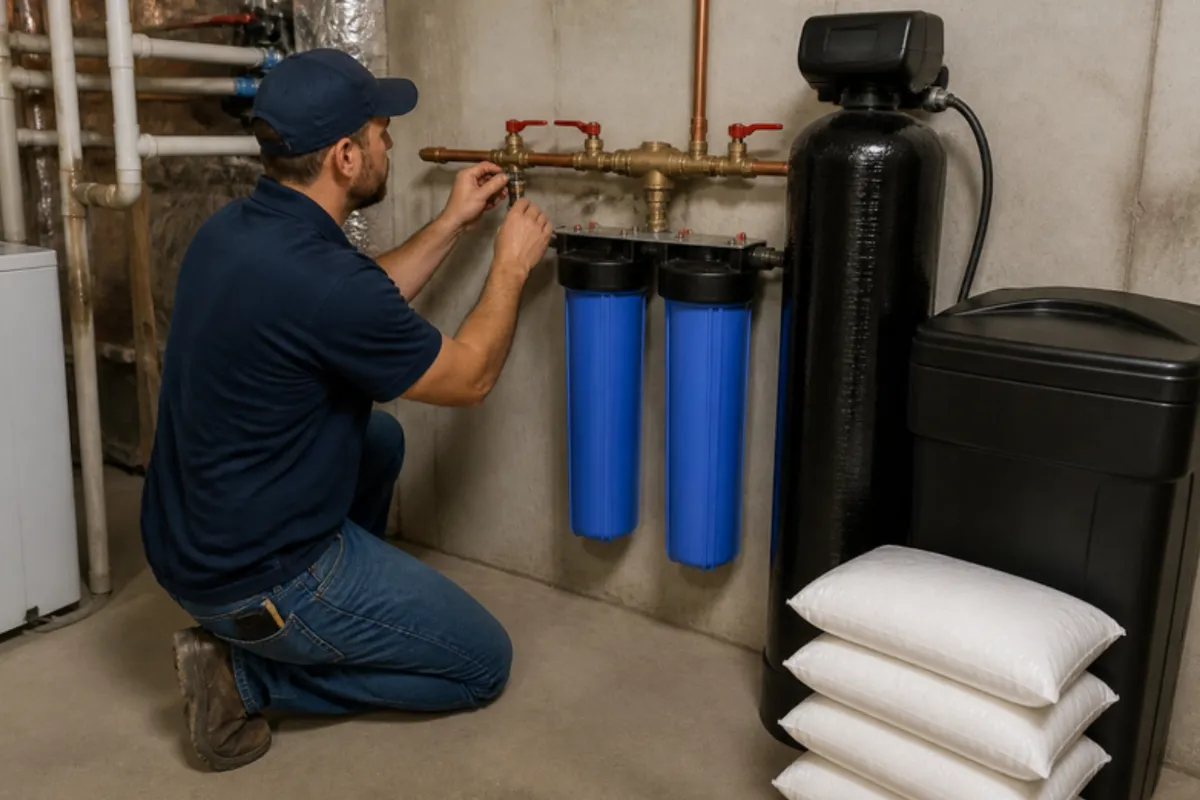
Usually not on its own. A softener removes calcium and magnesium. It can catch small amounts of iron, but heavier iron or manganese tends to foul the resin, and those usually call for a dedicated filter upstream. Rotten-egg odors and bacteria need their own treatment. Jefferson County also notes that radon occurs naturally in many county groundwater supplies, which is one more reason a full test beats guessing. The order of equipment matters: sediment and iron filtration first, then softening, then anything for drinking water at the kitchen tap.
Where does the softener's discharge go?
Most Conifer homes are not on municipal sewer and use private onsite wastewater systems. A softener's regeneration water goes down the drain into that system. A plumber can keep the volume down with a demand-based valve and set the regeneration schedule from your actual hardness and use, rather than a timer that runs whether it is needed or not. The Village at Conifer commercial area is the exception, with water and wastewater service from Aspen Park Metropolitan District.
Local note
Conifer is unincorporated, so plumbing permits come from Jefferson County Building Safety, which takes applications online. At about 8,262 feet, Conifer gets cold, so softeners and filters belong in heated space, not in an unheated garage or shed where a frozen valve can crack. If the well system is already in a heated utility room with the pressure tank, that is usually the best place for treatment equipment too, since it keeps every part of the setup in one spot that stays warm and is easy to reach for service.
Water Softeners & Filtration questions in Conifer
What should a private well be tested for before picking equipment?
Can a softener be used on a home not on municipal sewer?
Will a softener take out iron or manganese?
Can a softener sit in a garage through a Colorado winter?
More plumbing services in Conifer
Water Softeners & Filtration nearby
Helpful guides
Sources
Last updated: