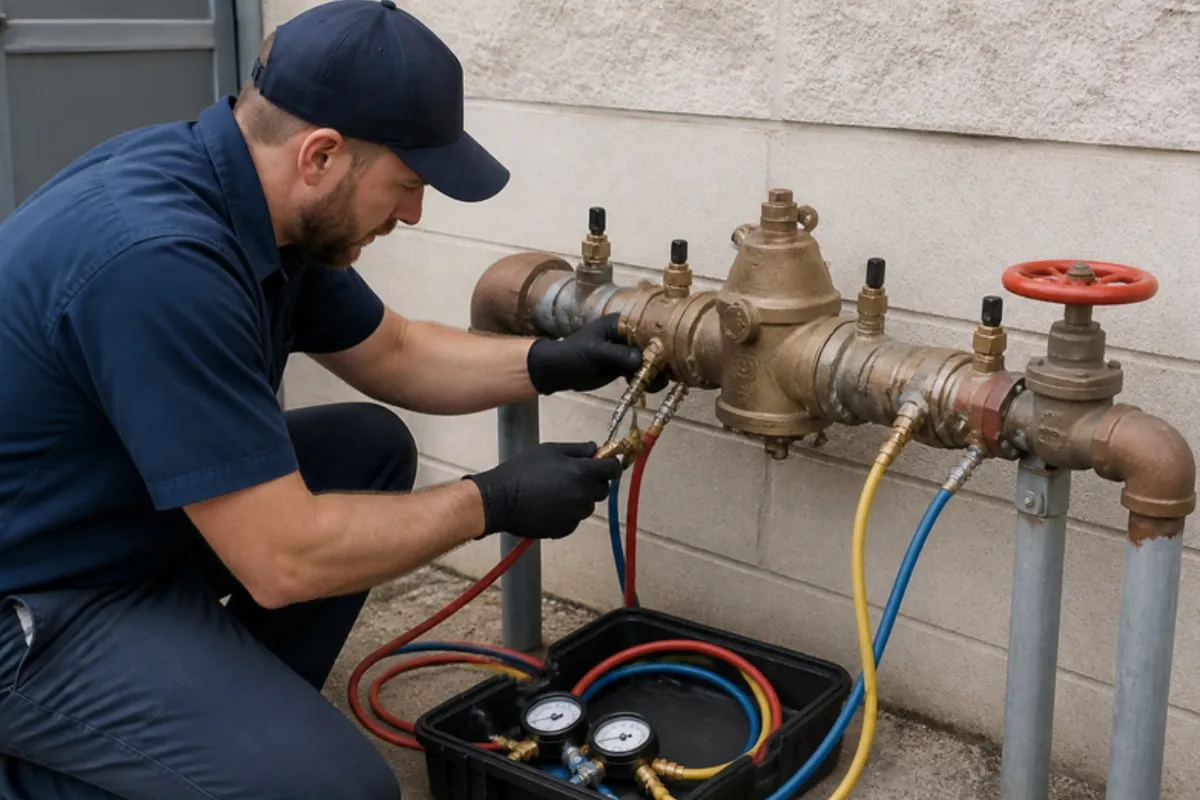
Denver Water requires approved backflow prevention assemblies on commercial, industrial, irrigation and fire line services, and it assesses homes based on site hazards. Each assembly must be tested when it is installed and every year after that by a certified tester, with the results reported to Denver Water's Cross-Connection Control office. Call the number on this page to be connected with a local plumber in Denver who performs backflow testing and repair.
Why Denver Water cares about backflow
Backflow is water moving the wrong way, out of a building or sprinkler system and back toward the public supply. It can happen through backsiphonage, when pressure in the main drops during a main break or heavy firefighting draw, or through backpressure, when a pump or boiler pushes building pressure higher than the street. An assembly at the service keeps that water from reaching the system everyone drinks from.
Who has to test
- Commercial and industrial services: an approved assembly is required.
- Irrigation services: must be protected by a reduced pressure principle assembly (RP) or a pressure vacuum breaker (PVB). Denver Water does not allow atmospheric vacuum breakers for irrigation.
- Fire lines: an assembly is required, and the tester also needs a Colorado Fire Suppression System Contractor-Backflow certification.
- Homes: requirements for single-family and multifamily residences depend on the hazards at the site.
- Properties with a well or pond: an auxiliary supply means an assembly must be installed and maintained.
How the yearly cycle works
- The assembly is tested at installation, then once a year.
- The tester must hold ABPA or ASSE backflow certification.
- Test reports go to Denver Water's Cross-Connection Control office.
- Irrigation assemblies are tested from May through September as systems are turned on, and Denver Water sends a reminder before a test is due.
When the test fails
A failed test usually points to worn check valves, a fouled relief valve, torn rubber parts or debris caught in the assembly. Many can be rebuilt with a repair kit and retested the same visit. Older or damaged units may need replacement. Installing a new backflow preventer at a single-family home or duplex is a Denver quick permit through Community Planning and Development.
Sprinkler assemblies and Front Range winters
Irrigation assemblies sit outside, and hard freezes with fast temperature swings can crack bodies and bonnets that still hold water. Draining the assembly and blowing out the lines each fall prevents most spring surprises.
What affects the cost
Pricing depends on the assembly type and size, how many assemblies are on the property, access to the vault or enclosure, whether parts or a rebuild are needed, and whether a replacement and permit are involved.
Backflow Testing questions from Denver homeowners
How often do backflow assemblies need testing in Denver?
Who can test my backflow preventer?
When are irrigation backflow tests done?
Does my house need a backflow assembly?
Related plumbing services in Denver
Helpful guides
Backflow Testing in nearby cities and towns
Arapahoe County
Jefferson County
Adams County
Douglas County
Broomfield County
Boulder County
Weld County
Elbert County
Park County
Gilpin County
Clear Creek County
Sources
Last updated: